Object-Oriented Programming
Algorithmic Decomposition
Michael L. Collard, Ph.D.
Department of Computer Science, The University of Akron
Software can be …
- complex
- "has many parts"
- complicated
- "has a high level of difficulty"
- Need design approaches to deal with complexity and complicated code
Decomposition
Breaking a complex problem or system into a collection of smaller parts
- Start with the initial problem or system and apply decomposition recursively
- With good design, the smaller parts improve modularity which improves maintainability and reusability
- Design answers the question: What parts do I need to solve this problem, and how do these parts relate to each other?
- Possible tradeoffs: efficiency
Decomposition Advantages
When performed correctly, the smaller parts are easier to:
- Design
- Implement
- Comprehend
- Test
- Maintain
- Reuse
Algorithmic Decomposition
Breaking a complex algorithm into a collection of smaller algorithms
- Start with the initial algorithm and apply algorithm decomposition recursively
- With good design, the smaller algorithms improve modularity which improves maintainability and reusability
- Design answers the question: What algorithms do I need to solve this problem, and how do these algorithms relate to each other?
- Possible tradeoffs: efficiency
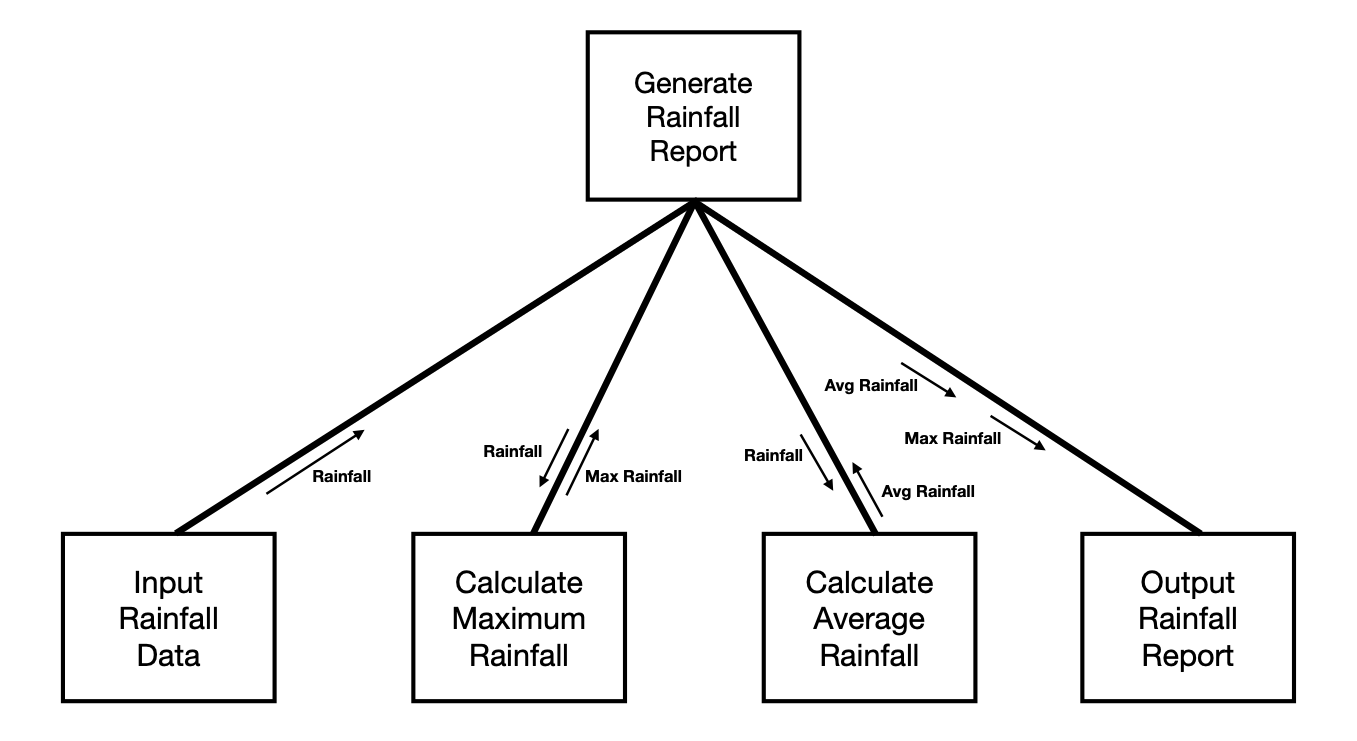
Rainfall: Algorithmic Decomposition
- Input rainfall data
- Calculate maximum rainfall
- Calculate average rainfall
- Output the rainfall report
Modeling Decomposed Structure
- Data-Flow Diagram (DFD)
- Shows data exchanged between elements
- Hierarchy Chart or Organization Chart
- Shows levels of elements
- Structure Chart
- Shows levels of elements and the data exchanged between the elements
Structure Chart
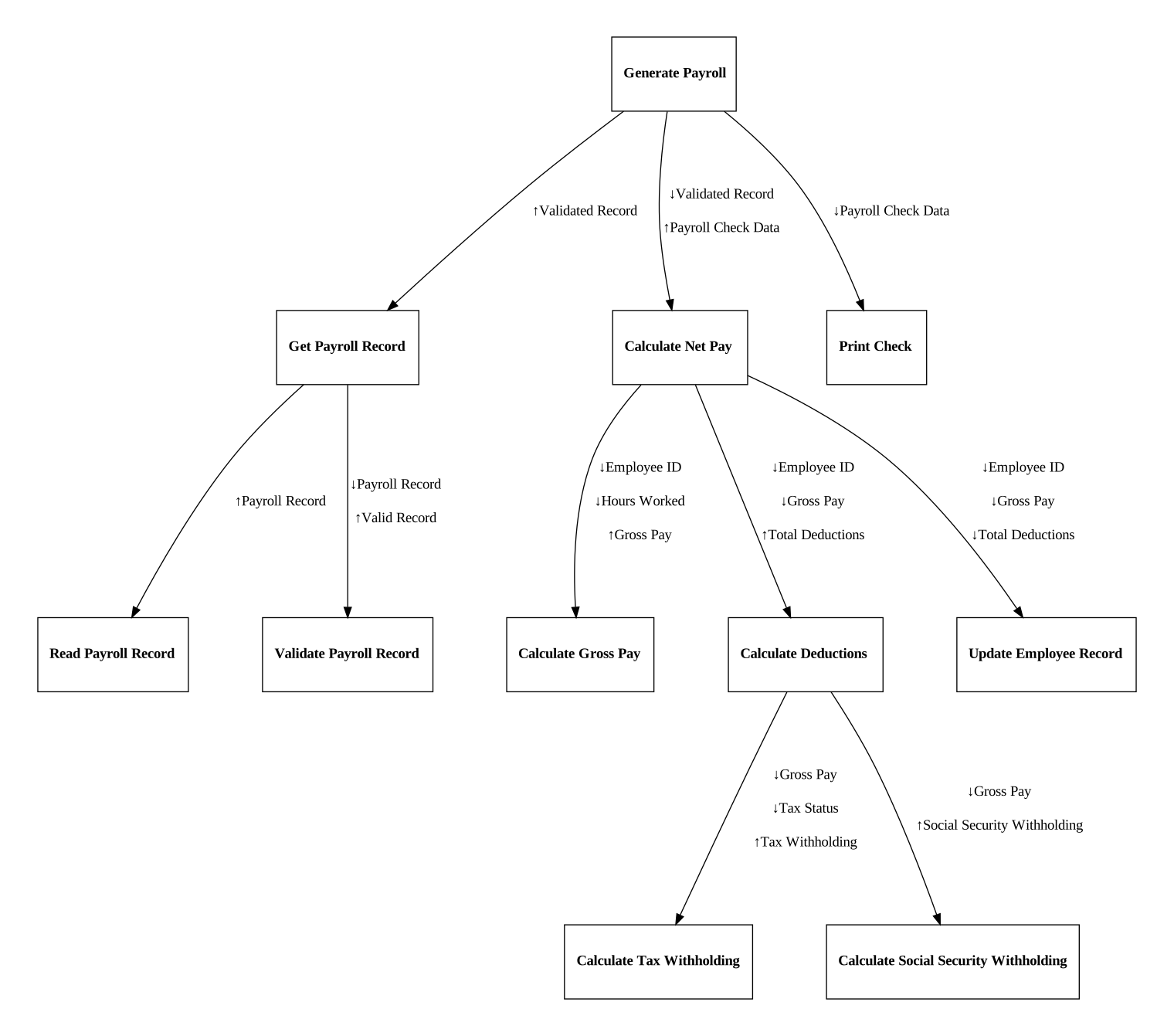
Rainfall: Structure Chart
Function Decomposition
Breaking a function down into a collection of smaller functions
- Start with the main() function and apply function decomposition recursively
- With good design, the smaller functions improve modularity which improves maintainability and reusability
- Design answers the question: What functions do I need to solve this problem, and how do these functions relate to each other?
- Possible tradeoffs: efficiency
What Functions Care About and Algorithms Don't
- Input source and format
- Where did the array data come from?
- Output source and format
- Where is the data going?
- Exact syntax used
- What language features do we use?
- Interface
- What name, parameters, and return type do the functions have?
- Options and exceptional cases
Structure Chart
Rainfall: Structure Chart
Information Hiding
Hide the internal details of a part, algorithm, or function, and only expose the minimal interface
- details can be specific values, complex operations, complex series of operations, knowledge, etc.
- interface includes what we pass and the direction, i.e., IN, OUT, and IN/OUT
- This is what gives decomposition its advantages
Relation to functions
- Functions created by algorithmic decomposition work only on the data in the parameters given (IN, OUT, and IN/OUT)
- These functions are operations, actions, etc., on some data
Interface and Functions
- Name
- Parameters
- Return Type
Direction and C++ Parameter Types
| Direction | Example | Type |
|---|---|---|
| IN | void f(int data); |
value |
void f(const Data& data); |
const reference | |
void f(const Data* data); |
const pointer | |
| OUT | void f(int& data); |
reference |
void f(Data& data); |
reference | |
void f(Data* data); |
pointer | |
void f(Data** data); |
pointer to pointer | |
int f(); |
return | |
Data f(); |
return | |
const Data& f(); |
return | |
| IN/OUT | void f(int& data); |
reference |
void f(Data& data); |
reference | |
void f(Data* data); |
pointer | |
void f(Data** data); |
pointer to pointer |
C++ Parameter Types and Direction
| Type | Example | Direction |
|---|---|---|
| value | void f(int data); |
IN |
| const reference | void f(const Data& data); |
IN |
| reference | void f(int& data); |
OUT |
void f(Data& data); |
OUT | |
void f(int& data); |
IN/OUT | |
void f(Data& data); |
IN/OUT | |
| const pointer | void f(const Data* data); |
IN |
| pointer | void f(Data* data); |
OUT |
void f(Data* data); |
IN/OUT | |
| pointer to pointer | void f(Data** data); |
OUT |
void f(Data** data); |
IN/OUT | |
| return | int f(); |
OUT |
| return | Data f(); |
OUT |
| return | const Data& f(); |
OUT |
functions and State
- In general, free functions do not save state between calls; they do not have any internal "memory" between calls
- Parameters and local variables are created when the function is called and destroyed when the function call returns
- Mostly exhibit consistent behavior, i.e., if passed same data, produces the same result
- There are ways around this but use object-oriented approaches instead
Approaches to Decomposition
- Top-Down Design
- Start with the root of the tree and work down decomposing at each level
- Bottom-Up Design
- Start with the leaves of the tree and combine them level-by-level
- Experts use a combination of the two and often switch during the design process
Top-Down Design
- 1) { Generate Payroll }
- 2) { Get Payroll Record, Calculate Net Pay, Print Check }
- 3) { { Read Payroll Record, Validate Payroll Record }, { Calculate Gross Pay, Calculate Deductions, Update Employee Record } }
- 4) { Calculate Tax Withholding, Calculate Social Security Withholding }
Bottom-Up Design
- 1) { Calculate Tax Withholding, Calculate Social Security Withholding }
- 2) { { Read Payroll Record, Validate Payroll Record }, { Calculate Gross Pay, Calculate Deductions, Update Employee Record } }
- 3) { Get Payroll Record, Calculate Net Pay, Print Check }
- 4) { Generate Payroll }
Algorithmic Decomposition and OOP/OOD
- A lower-level approach is needed for OOP/OOD
- Algorithmic decomposition only scales so far
- The primary challenge of modern applications is not algorithmic complexity but the sheer number of things to keep track of
- Core algorithms for a particular problem often do not change over time, but surrounding code does, e.g., input formats, output formats