Object-Oriented Programming
Errors and Exception Handling
Michael L. Collard, Ph.D.
Department of Computer Science, The University of Akron
Importance of Error Handling
- Often ignored and more complex than anticipated
- Design for the "happy path": method naming, parameter types, etc.
- Design of error handling for the non-happy path (unhappy path) introduces further complexity to an already existing API
- Includes what indicates an error, e.g., int values, strings, and what errors map to which particular values
Error Handling Choices
- Error Return
- Error Parameter
- Global State
Error Return
- Return error code
- Typically, an
intorbool - Check value after each use (which is easy to forget)
- Return error may be mixed into normal processing return
Error Parameter
- A parameter contains an error code
- Similar to error return except not mixed with normal processing return
- Have to declare a variable before the call
Global Error Value
- A global variable contains the error results
- May be mixed with error return or error parameter for more information
- For
perror(), the globalerrnocontains the last error code perror()usage in the Linux kernel …- Code to reset or get the global, shared value may be confusing
Problems with Error Codes
- Do not work with constructors, as constructors do not return a value
- Error codes do not have consistent values across applications
- libarchive
- libcurl
- Numeric results are not obvious, and name forms are often used/needed
- Propagating an error code is tedious
Error Propagation Flow
- Calls to
h()only geth()errors - Calls from
h()tog()andg()tof()are not propagated - Every call to a function with an error return or parameter must pass on that error to the calling function
- Disturbs normal processing
- Even with one layer missing, it breaks the error propagation
- Not easy to do correctly
Exception Handling by Keyword
throw- Where an error is detected, the function/method immediately returns from that point in the code
catch- Layered calls are returned (stack unwinding) until one that matches is found
try- The
catchis associated with the code in thetryblock
Resumption vs. Termination
Resumption Semantics
- When the code generates an exception, go to where caught, process catch, and then return to the original point in the code
- C++ does not suppor resumption semantics (but some language do)
- Was under consideration for C++ in the early days of C++ exception handling
Termination Semantics
- When the code generates an exception, go to where caught, process catch, and continue in the code at the catch point
- C++ only supports termination semantics
How to use Exceptions
Exception-handling code is error-handling code
- Separates the "good path" (or "happy path") from the "bad path"
- Errors where the code cannot handle the error locally, e.g., a constructor
- Do not use exception handling for normal processing
- Since they automatically deallocate, RAII is a crucial technique to use for all variables
Why RAII is Important
Partial std::exception Hierarchy
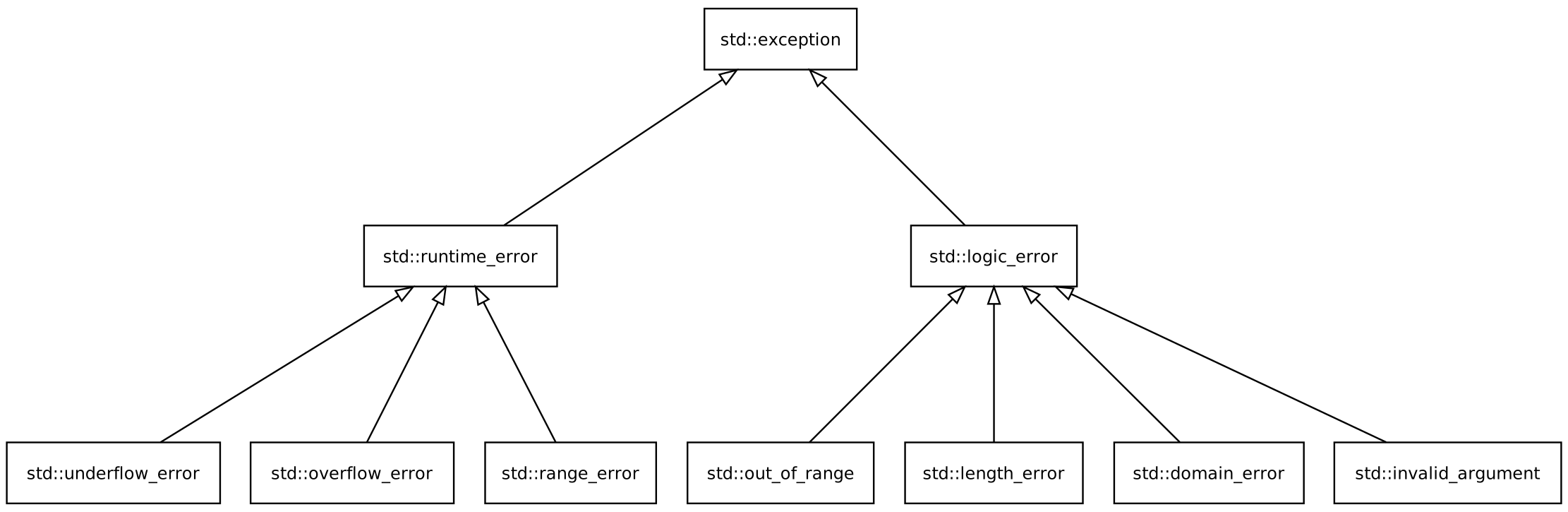
std::logic_error
faulty logic within the program, such as violating logical preconditions or class invariants, and may be preventable
std::invalid_argument- Argument value is not accepted
std::domain_error- Inputs are outside of the domain defined for the operation
std::length_error- Exceeds implementation-defined length limits for some object
std::out_of_range- Access elements out of the defined range
std::runtime_error
errors due to events beyond the scope of the program and where the program code cannot easily predict the error
std::range_error- The destination type cannot represent the result of a computation
std::overflow_error- Arithmetic overflow errors, i.e., the result of a computation is too large for the destination type
std::underflow_error- The result of a computation is a subnormal floating-point value
catch Handlers
- Parameter modifiers
constandvolatileare ignored catch (...)matches any typecatch (Foo& e)matches any object of type Foo or any object of any class derived from Foo- Order matters: Put derived class catch handlers before base class catch handlers
Goal: One try per Function
function try block
Recommendations
- Throw objects instead of scalar values
- It is possible to throw any type, including
intandchar*, but more challenging to determine what the error is - Throw objects derived from
std::exception - That way,
catchhandlers forstd::exceptionwill catch yourthrow - Catch by reference, i.e.,
& constis thrown away; not concerned about the advantages of const at this point- Can also catch by pointer, but pointers cause the question: "Who should free?"
Constructors
throw;
Exception Dispatcher: Re-Throw Idiom
noexcept specifier
- Current:
- non-throwing -
void f() noexcept; - potentially throwing -
void f(); - Deprecated:
- non-throwing -
void f() throw(); - potentially throwing -
void f() throw(std::exception);
Other Issues
- C++ has no "finally"; use RAII instead
- Exception handling may or may not be slow but shouldn't cause a slowdown of normal processing
- If a framework throws pointers, use pointers (e.g., MFC)
Overall Design
- Inherit from the standard exceptions, e.g.,
std::exceptionand family - In general, one
tryblock per function. It is a good idea to extract a function if more than one is needed. - Organize around the logical reason for the exception, not the source (e.g., subsystem)
- E.g., Banking app, Reason: "insufficient funds", Subsystem: One of many
- Design for the entire system
- Avoid a layer-by-layer design
Scenario: Starting Code
Scenario: Adding Exception Handling
Scenario: Summation
- In C++, the destructor cannot be called for a partially-constructed object
- When a constructor throws an exception, the destructor of the class cannot clean up fields/data members; the fields/data members have to clean up themselves
- Every data member should have RAII semantics and not rely on class destructor where they are fields
- True RAII classes have to be careful when they throw exceptions in the constructor