Object-Oriented Programming
UML Class Diagrams
Michael L. Collard, Ph.D.
Department of Computer Science, The University of Akron
Communicating Class Design
- Textual description
- C++ code
- UML Class
UML Diagrams
UML Class
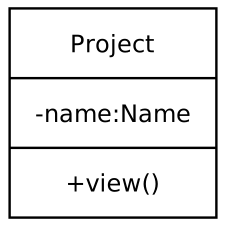
- A static, structure diagram
- Name
- Attributes - data members/fields
- Operations - methods/member functions
Partial Meta-Object Facility (MOF)
| Level | Name | Description | Example |
|---|---|---|---|
| M2 | metamodel | UML Syntax |  |
| M1 | model | UML Model |  |
| M0 | data layer | Real World |  |
Role of Classes
- Classes represent the parts of the program
- … they are entities, not actions
- … PascalCase, e.g., Project, UndergraduateStudent
- Operations are the actions of the class
- … like free functions, they are in the verbTarget form
- … typically use (at the model level) camelCase
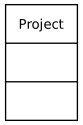
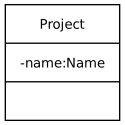
Multiple Views

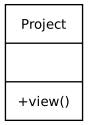
Visibility
+public-private#protected~package
UML Primitive Types
- Integer
- UnlimitedNatural
- Real
- Boolean
- String
Attributes: visibility name:type multiplicity = default {property-string}
| Attribute Syntax | Description |
|---|---|
+name |
public name |
-name |
private name |
-name:Name |
private name of type Name |
-name:Name = "Project" |
private name of type Name with default "Project" |
-name:Name[3] |
private name of type Name with multiplicity of 3 |
-name:Name = "Project" { persistent } |
private name of type Name with the default "Project", and property 'persistent' |
Operations: visibility name(parameter-list):return-type {property-string}
| Operator Syntax | Description |
|---|---|
+draw() |
public operator draw() |
-draw() |
private operator draw() |
#draw() |
protected operator draw() |
+draw() : Boolean |
public operator draw() with return type Boolean |
+draw() : Boolean {optional} |
public operator draw() with return type Boolean, and a property optional |
Operation Parameters: direction name:type = default
| Parameter Syntax | Description |
|---|---|
+draw(: Shape) |
parameter of type Shape |
+draw(s: Shape) |
parameter s of type Shape |
+draw(in shape : Shape) |
in parameter shape of type Shape |
+draw(out picture : Picture) |
out parameter picture of type Picture |
+draw(inout picture : Picture) |
inout parameter picture of type Picture |
Parameter Directions in C++
| C++ Declaration | UML Parameter Direction |
|---|---|
| Shape | in |
| const Shape& | in |
| const Shape* | in |
| Shape& | inout |
| Shape& | out |
| Shape* | inout |
| Shape* | out |
| Shape** | out (typical API usage) |
Multiplicity
| Multiplicity Syntax | Description |
|---|---|
* |
Any number of values |
1 |
Single value (default) |
0..1 |
No more than a single value |
2..4 |
Two to four values |
Multiplicity Terms
| Multiplicity Term | Description |
|---|---|
| Optional | * |
| Mandatory | 1..* |
| Single-valued | 0..1 |
| Multivalued | 0..2, 0..* |
- For a multivalued UML attribute, use a container, e.g., in C++,
std::array,std::vector,std::deque,std::list,std::forward_list - For single-valued UML attribute, use an optional type or pointer if not available, e.g., in C++,
std::optional(C++17)
Stereotypes
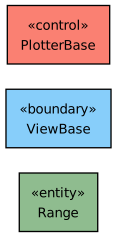
- stereotype is an extension mechanism to UML used as part of profiles
- keyword is a formally defined stereotype
- CBE - Control, Boundary, Entity
Static Attributes and Operations
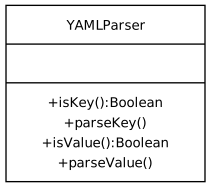
- No free functions in UML
- Static operations do not have an object
- Static attributes are shared among all objects of the class and can be used (in static operations) even without an object
- Operations and attributes that are static are indicated in UML with an underline
- Note: No parameters in UML does not mean there are no parameters. In this case, we don't care about that level of detail. The level of detail depends on the purpose of the model.
Static UML & C++
Notes
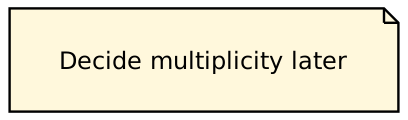
- Use text to clarify diagram/design
- The UML "comment" mechanism
- No formal definition of note content
Guidelines
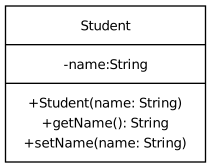
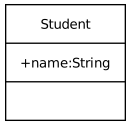
- Attributes show the state of the objects and may not map directly into types in the implementation language
- Show only the attributes and operations (methods) necessary for the given purpose
- Public attributes typically map to get and set (stereotype) methods in the code
- Only display constructors if needed
Forward Engineering: Model to Code
Reverse Engineering: Code to Model
UmlMode [Fowler]
UmlAsSketch
- UML to communicate an aspect of a system
- forward engineering - sketches to work out design before implementation
- reverse engineering - sketches for comprehension
- Main feature: Selectivity
- Requirements: Need to be performed quickly and collaboratively using a whiteboard or paper
UmlAsBlueprint
- Express design enough to hand off to another group
- forward engineering - Every detail needed to implement the design
- reverse engineering - Every detail of what design is in the code
- Separation of labor: High-end designers versus "coders"
- Main feature: Completeness
UmlAsProgrammingLanguage
- Provide enough detail to compile executable code from UML
- Promise: "UML is more productive than current programming languages"
- Reality: Graphical languages are not always better, e.g., flow chart versus pseudocode
- Reality: The "best" languages are not always the most successful
Current View
And, IMHO, the UML standard started going off the rails when some started morphing it to be a programming language with formal semantics. Visual representations are, by their very nature, abstractions, not precise representations.