Object-Oriented Programming
UML Class Relationships
Michael L. Collard, Ph.D.
Department of Computer Science, The University of Akron
Properties: Attributes & Association

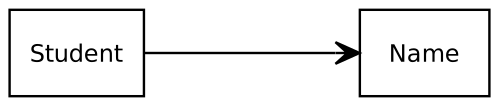
- Another notation for property (alternative to attribute)
- Use attributes for properties that are datatypes, e.g., primitive types or whatever is considered a data type in your design
- Use an association for a class, especially if the methods of the class are of interest at the design level
- Is String a class or a datatype?
| DataType | Class |
|---|---|
| Primitives | Objects |
| Methods are familiar | Methods are not familiar |
| Operators do not change | Operators can change |
| New developers know precisely what you mean | New developers have only a vague idea |
| Tend to be scalar (single value) | Tend to be complex types |
| Equivalent values ⇨ same identity | Two distinct objects can have the same value |
| Probably not a base for generalization (inheritance) | Maybe a base for generalization (inheritance) |
Class Relationships
- Object-Oriented Design: What classes make up this system?
- Multiple classes ⇨ relationships between classes
- Existence and kinds of relationships between classes are the central part of a UML Class Design
UML Class Relationships
| Relationship | Description |
|---|---|
| Dependency | uses a |
| Association | has a |
| Aggregation (Association) | has a |
| Composition (Association) | has a |
| Generalization | is a |
Relationship
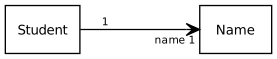
- directionality
- multiplicity
- labels
Association
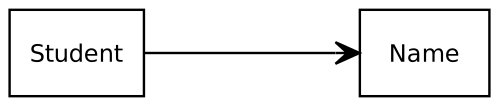
Association
- One class has a(n) element of another class
- Represented in UML by a solid line with an arrow
Dependency

Dependency
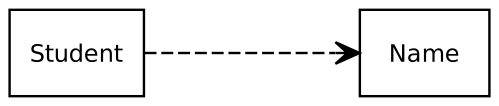
- Class used as a parameter or local variable only (not a field/data member) results in a dependency
Dependency Discussion
- Represented in UML by a dashed line with an arrow
- Changes to the definition of the supplier/source (e.g., Tokenizer) may cause changes to the client/target (e.g., Student)
- Dependencies are weaker than Associations and therefore preferred
Dependency & Association
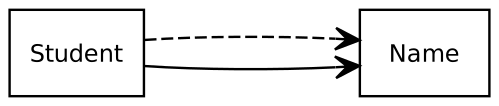
Dependency & Association
- Show the strongest relationship only
Strong Relationships
| Strength | UML Relationship |
|---|---|
| Strongest | Generalization (Inheritance) |
| Stronger | Composition |
| Strong | Aggregation |
| Strong | Association |
| Weak | Dependency |
| Weakest | Realization (Implementation) |
- Can rank the strength of relationships
- Association is a stronger relationship than Dependency
- Strong relationships are not good
- Any relationship implies coupling, overly strong coupling is not good design
- The stronger the relationship, the more constrained and rigid the design is
- Prefer Dependency over Association
Scenario: Original Design
Scenario: Name removed
Substitutability: Liskov Substitution Principle
Subtype Requirement: Let ϕ(x) be a property provable about objects x of type T. Then, ϕ(y) should be true for objects y of type S where S is a subtype of T.
- We can substitute type S objects for type T objects
- Not just interface (syntax), but behavior (semantics)
- Typically referred to as an "is a" relationship
- [Liskov,Wing'94]
Generalization

- Expression of is a relationship: Substitutability
- Maps directly to inheritance in most OOP languages
- Subclass/subtype/derived class is a generalization of superclass/supertype/base class
- Highest semantically defined relationship
- Represented in UML by a solid line with a hollow arrowhead
Inheritance
- In C++, Generalization is public inheritance
Problems with Generalization
The purpose of generalization is to solve design problems. If you don't have a design problem, don't use generalization.
- Inheritance and inheritance hierarchies are more challenging to get right than realized
- The developer needs to create classes with inheritance in mind. Most classes are not designed for this, e.g., C++ standard library
- Often overused. In general, prefer association over generalization
Substitutability Violation #1
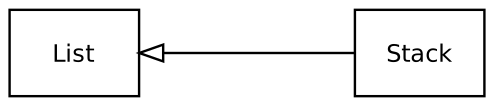
Violation Solution #1
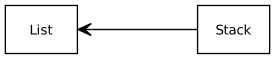
Substitutability Violation #2

Violation Solution #2

Abstract Classes/Methods
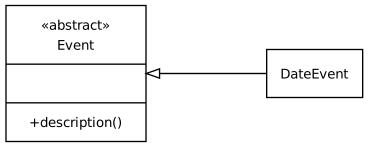
- Abstract classes do not support direct instantiation, e.g., you can create a DateEvent object but not an Event object
- An abstract class typically has one or more abstract methods. An abstract method is a method that is declared but not defined in the class, and a derived class must provide a definition.
- Displayed (both classes and methods) as Event or with a label {abstract}, or abbreviated label {A}
Interfaces
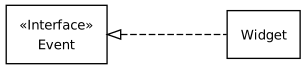
- All operations are public, and no operation has a method body
- Cleanly models interfaces in Java, C#, COM, CORBA
- Indicated as keyword «interface», or with a label {interface}, or abbreviated label {I}
- In this case, inheritance means implementation
- We can also have a dependency relationship with an interface