Object-Oriented Programming
Dispatch
Michael L. Collard, Ph.D.
Department of Computer Science, The University of Akron
Dispatch
Selecting which implementation of an operation (method or function) to call
- static dispatch
- dynamic dispatch
Static Dispatch
Selecting which implementation of an operation (method or function) to call at compile time
- Which operation (method or function) will be called is determined at compile time
- As fast as a call can be made
- Preferred by the compiler for these reasons
C++ Static Dispatch
- The compiler uses static dispatch whenever it can:
- free functions
- non-virtual methods
- static methods
- method calls from non-pointer and non-reference variables
- Why? Less code to generate (program smaller)
- Why? Faster to call
Dynamic Dispatch
Selecting which implementation of an operation (method) to call at run time
- For virtual method calls whose object is a pointer or reference
- Requires more code than static dispatch
- Slightly slower to call
- Compilers have optimized dynamic dispatch, so the speed disadvantage is smaller than it used to be
Original class Shape
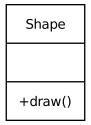
Problem for Dynamic Dispatch
- Methods through the pointer parameter
pshapeand the reference parametershapecalls may not exist yet - The functions
apply()are compiled so that for any class that inherits from the class Shape, the function calls the proper method - Even though the parameter type at the time of compilation was a
Shape*or aShape&, theapply()functions must call the Shape methods for Shape objects and derived methods for objects of derived classes
Add class Circle
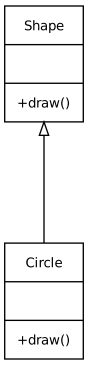
Problem for Dynamic Dispatch
- New methods now exist
- Original
apply()code existed and was compiled long before class Circle was created - The original
apply()code in this case must callCircle::draw()
How? vtable
- At compile time, the virtual table or vtable is created to store the information required for the dynamic dispatch of virtual methods for a class
- For every object of a class that has a vtable, the object has a pointer to the class vtable
- Method calls go through the vtable for the class of an object
- We will examine the vtable structure in detail at a later date