Object-Oriented Programming
UML Generalization
Michael L. Collard, Ph.D.
Department of Computer Science, The University of Akron
UML Class Relationships
| Relationship | Description |
|---|---|
| Dependency | uses a |
| Generalization | is a |
| Association | has a |
| Aggregation (Association) | has a |
| Composition (Association) | has a |
Generalization Terminology
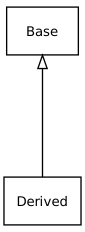
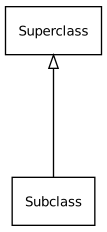
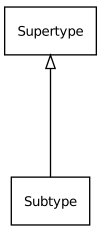
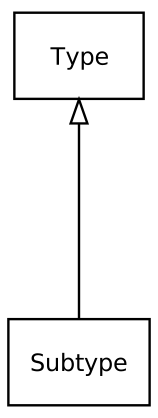
Problems with Generalization
The purpose of generalization is to solve a design problem. If you don't have a design problem, don't use generalization.
- What design problems does generalization solve?
Scenario: Multiple Related Classes
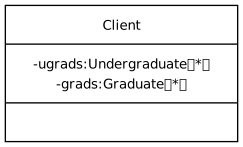
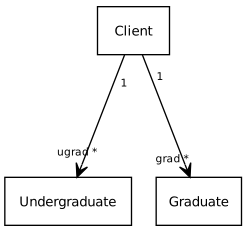
Problems
- If new kinds of students are added, we have to add more loops
- Every new processing we add has to know about both undergraduate and graduate students
- Have to remember to add new operations to both
- Three different concepts:
- Undergraduates
- Graduates
- Students - applies to both undergraduate and graduates
Solution
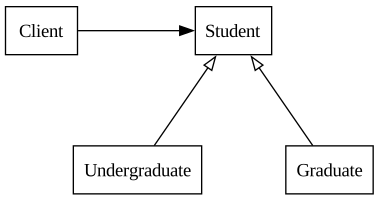
Solution
- Client has a Student (Association) but is totally decoupled from Undergraduate/Graduate
- Does Liskov hold? An is a relationship?
- ✓ An undergraduate is a student
- ✓ A graduate student is a student
- Single piece of code to manage any type of Student
- New kinds of Student can be added without changing the client code
Bidirectional Association
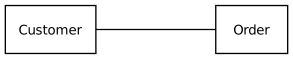

- Customer has an Order
- Order has a Customer
Problems with Bidirectional Associations
Solution
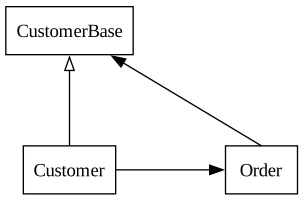
- Extract only the part needed
- Customer has an order
- Order has a CustomerBase
- Customer is a CustomerBase
Solution Code
Advantages
- Develop and test class CustomerBase individually
- Develop and test classes Order & CustomerBase together
- Develop and test classes Customer & CustomerBase together
- Often, class CustomerBase would be very small and simple, mostly to define an interface
Polymorphism
In general: The condition of occurring in several different forms
For design: A single interface to entities of different types
- Same interface for different types
- Which code is run depends on the type of the object
Static Polymorphism
- Determined at compile time
- static dispatch
- In C++:
- overloading (function and operator)
- templates
Without and With Method Overloading
Without and With Method Overloading
Method Overloading
- Code is more flexible as parameter types can change
- It is easier to remember the correct method names and parameters
- Completely determined at compile-time
- Can disguise significant differences in behavior
- Can lead to bland and meaningless names, e.g.,
process()
Dynamic Polymorphism
- Determined at run time
- dynamic dispatch
- In C++ requires
virtualmethods - Lots of flexibility
- Slight speed disadvantage
- Extra memory to support the mechanism (vtables, vtable pointers)
Dynamic Polymorphism
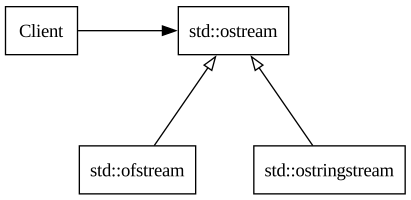
Back To Students: What about Methods?
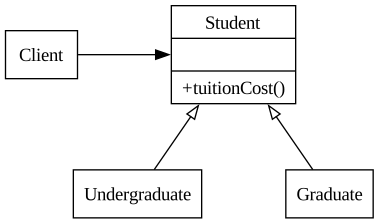
- Of course, any Student object has
tuitionCost() - Due to the is a relationship, so does any Undergraduate or Graduate object
Scenario
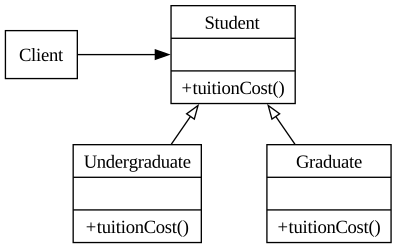
- What if the classes Undergraduate and Graduate need different implementations for
tuitionCost()? - Could add the method to each (and implement it differently)
override
An override is when a derived class redefines a virtual method of the base class
- With UML Generalization, we assume that all methods are virtual
- Overriding is what provides the dynamic polymorphism
- Non-virtual and static methods cannot be overridden in C++
C++
- Once a method is virtual in a base class, it is virtual in all derived classes
- The
virtualspecifier is often also applied to the method in the derived class, but that is not necessary. A better approach is to use theoverridespecifier placed after theconst.
Design Questions
- Does it make sense to have a student who is neither an undergraduate nor a graduate student?
- Perhaps all students should be one or the other? (at least for now)
- How do these get formed? How are the correct objects created?
Methods
Abstract Class
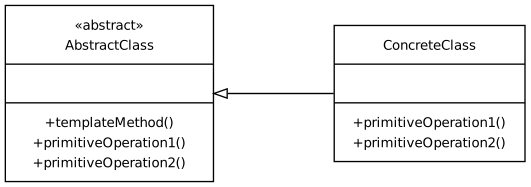
- Consists of at least one pure-virtual method
- Cannot create objects of that class type
- Can only create objects of derived classes that implement all the pure-virtual methods
Interface
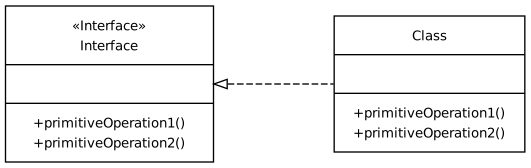
- Consists of all pure-virtual methods
- Sometimes, all empty methods
- However, many times, the term is used interchangeably with Abstract Class
Virtual Design Choice
Pure Virtual Design
- No pure
CustomerBaseobjects - A derived class must override and implement all pure virtual methods to create objects
- If all methods are pure virtual, then we potentially have an interface
Empty Virtual Design
- Pure
CustomerBaseobjects - A derived class picks and chooses which methods to override